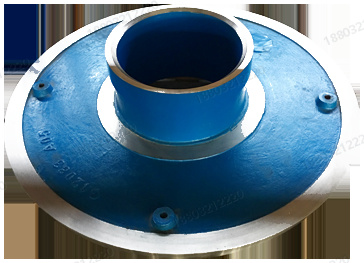
Slurry Pump Wetted Part MaterialsA05, Cr26, A49, Cr30A and rubber — chosen by duty
Changing the grade on the same pump can multiply wear life. The decision rests on particle size and shape, pH and chloride, and slurry temperature — not on hardness alone.
We supply wetted parts in two families: high-chrome iron, split into A05, A49 and Cr30A by corrosion requirement, and rubber lining for fine-particle corrosive duty. The table below sets out hardness, corrosion limits and typical applications.
Hardness answers abrasion only. Corrosion and temperature are solved by the matrix and the alloying elements, not by raising HRC.
Particle size and shape set the wear rate. Fine particles cut and plough; coarse angular particles impact and chip. Two slurries that both read "sand" can point to opposite material choices.
pH and chloride decide whether metal is viable. Acid and chloride attack the matrix first, then the carbides fall out. Raising hardness does not fix that.
Above 65 °C, confirm separately. FGD slurry pumps are commonly limited to 65 °C. Rubber linings and some grades lose life beyond that.
GRADE COMPARISON
Grades we supply and where they belong
Hardness figures are published values. Entries marked "per test certificate" have no public figure and are not estimated here.
Grade
Type
Hardness
Corrosion resistance
Typical use
A05 (KmTBCr26)
High-chrome white iron
HRC 58–62
Alkaline slurry; not for strong acids
Impellers, volute liners, throatbushes and frame plate liners
FGD casings and back cover plates, interchangeable with 2605N
Natural rubber
Elastomer lining over a steel core
Per compound (Shore A)
Dilute acids and alkalis, fine-particle slurry; not for oils or strong oxidisers
Impellers, liners and throatbushes in fine-particle corrosive duty
BEYOND HARDNESS
Hardness is not the only number that matters
Treating HRC as the sole criterion is the most common selection error.
Under coarse impact, harder can mean shorter life. High-chrome iron is hard and brittle. In parts hit by large particles, chasing maximum hardness produces chipping and spalling.
In corrosive duty, solve corrosion first. A49 is softer than A05 but its austenitic matrix survives pH 4 acid and high chloride, which is why FGD systems use A49 rather than A05.
Rubber is light and cheap, with clear limits. Rubber linings suit fine particles and mild corrosion and weigh a fraction of a metal part. Sharp coarse particles cut and tear the lining.
One pump can mix materials by location. A metal impeller with a rubber-lined volute is routine: choose per location based on local velocity, impact angle and wear pattern.
BY DUTY
Four typical duties and what we recommend
These are starting points; the slurry analysis and the wear pattern of the failed part take precedence.
Duty
Recommended
Reason
Coarse, angular, high concentration (tailings, mill discharge)
A05 / Cr26 high-chrome
Balances hardness with resistance to chipping; thick sections wear to limit
Fine particles, mild corrosion, alkaline pH (concentrate, coal slurry)
Rubber lining or A05
Rubber resists fine-particle cutting, is light and fast to change
Wet FGD gypsum slurry (pH 4–7, high chloride, ≤65 °C)
A49 wetted parts + 2605N / GLH-5 casing
Austenitic matrix resists acid and chloride; carbides resist gypsum wear
Alumina, chlor-alkali and similar corrosive abrasive duty
Corrosion grade plus dual mechanical seal
Corrosion dominates; seal and material upgrade together
REPLACEMENT
When to replace: wall thickness, not months in service
The same part can last several times longer in a different duty. Calendar-based replacement is neither economical nor safe.
Measure remaining wall thickness. At the deepest wear point, plan replacement when the remaining wall approaches half the original.
Watch the clearance. Impeller-to-throatbush clearance beyond range shows up as lost flow and head long before slurry leaks.
Read the wear pattern. Breakthrough, through cracks, or a lifted rubber lining are immediate replacement items.
Track the curve. Flow or head below the original record at the same speed means internal recirculation has increased.
FAQ
Slurry Pump Wetted Part Materials — frequently asked questions
Are A05 and Cr26 the same material?
A05 is the trade grade; KmTBCr26 is the standard designation for high-chrome abrasion-resistant white iron. They describe the same family. Order against the drawing and the mill certificate, since composition and hardness vary by heat.
Does higher hardness always mean longer wear life?
For fine-particle abrasion, broadly yes. For coarse impact duty, excessive hardness brings chipping risk. In corrosive duty hardness barely matters — the matrix decides.
Why use A49 instead of A05 in FGD pumps?
FGD gypsum slurry typically runs at pH 4–7 with high chloride. A05 matrix corrodes, then carbides spall. A49 is softer but its austenitic matrix resists the acid and chloride, giving longer overall life.
Can rubber parts run in coarse particle duty?
No. Sharp coarse particles cut and tear the lining; once it separates from the steel core the part fails quickly. Use high-chrome metal for that duty.
Can we change the material without changing the pump model?
Usually yes. Metal and rubber builds are interchangeable on some sizes, but the mating dimensions and fasteners must be checked — it is not a drop-in swap on every size.
Next step
Send the duty and we will name the grade
We need the slurry, the particle size and shape, weight concentration, pH, chloride content, temperature, and the pump model or a photo of the worn part. With those we can confirm the grade and the part number in one reply.