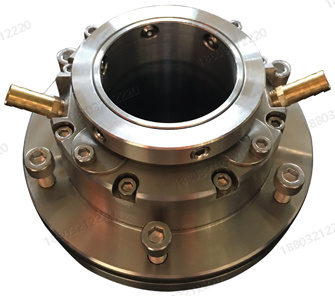
Slurry Pump Mechanical Seal TypesZGJ, ZHJ, ZWJ, DYZJ, WZ, HZ and SGBJM — how to choose
One pump can carry three different seals. The difference is not the pump: it is whether clean flush water exists on site, whether its pressure is sufficient, and whether the duty is a special case such as alumina or coal preparation.
Slurry pump mechanical seals divide first by flush condition — external, internal and dry running — then by pressure class and by special duty such as heavy duty, series pumps and alumina service. Selection starts with the site condition, not the pump model.
ZGJ-100, ZHJ-100 and ZWJ-100 are used on all the models listed above in addition to the 100ZGB. The remaining types are selected by pressure class and by specific duty.
SELECTION
Flush first, pressure second, special duty last
The order matters: the flush condition fixes the design, the pressure class fixes the face arrangement.
01
Is clean flush water available on site? No → ZWJ dry-running design. Yes → next step.
02
Can the flush pressure exceed the seal chamber pressure, and is external piping acceptable? Yes → ZGJ external flush. No → ZHJ / HZ internal flush.
03
Is the duty a special case (alumina, coal preparation, series pumps)? Yes → the dedicated type. Otherwise select within the standard range by pressure class.
INSTALLATION
A good seal fails quickly if it is installed wrong
Most seal failures trace back to flush conditions and installation, not to the part itself.
Dual seals need external flush above the sealed pressure. The medium-side and atmosphere-side faces are cooled by the slurry and the flush water respectively. Losing flush destroys the faces within minutes.
Cartridge designs are independent of shaft adjustment. ZGJ seals are set at the factory; spring compression is not re-adjusted on site.
Some misalignment is tolerated, but alignment still matters. Dual face seals run correctly with up to ±5 mm installation error; shaft and chamber concentricity and face squareness are still required.
External flush does not dilute the slurry. For duties with a concentration target, such as filter press feed or concentrate transport, external flush is the better arrangement.
FAILURE MODES
What fails and why
Read the face pattern first and work back to the operating condition; replacing the part alone rarely solves it.
Hard particles between the faces; dirty internal flush
Hardened, flattened O-rings
Temperature beyond the elastomer range or chemical incompatibility
Seized springs and drive parts
Scale build-up in hard water; axial compensation lost
Leakage at the outside diameter
Eccentric installation, face out of square, uneven gland bolt torque
FAQ
Slurry Pump Mechanical Seal Types — frequently asked questions
What is the difference between ZGJ and ZHJ?
Design and flush arrangement. ZGJ is a single-face cartridge seal with external clean water, so the flush never mixes with the slurry and concentration is preserved. ZHJ uses internal flush, typically where site conditions rule out external water.
What does the number in the seal type mean?
It corresponds to the pump size code — ZGJ-100 matches the 100ZGB family. Seal chamber dimensions differ between frames, so shaft diameter and chamber depth must be checked before ordering.
Can a dual seal run without flush water?
No. Both faces depend on the slurry and the flush water for lubrication and cooling; losing the flush burns the faces in a short time. Flush is a mandatory condition.
Mechanical seal or packing?
Use a mechanical seal where clean flush water is available and visible leakage is not acceptable. Packing tolerates large particles and poor maintenance better, and some models combine an expeller with packing.
Should the shaft sleeve be replaced with the seal?
Check it. A grooved, pitted or undersized sleeve will leak even under a new seal, so replace the sleeve and O-rings together in that case.
Next step
Send the duty and we will name the grade
We need the slurry, the particle size and shape, weight concentration, pH, chloride content, temperature, and the pump model or a photo of the worn part. With those we can confirm the grade and the part number in one reply.