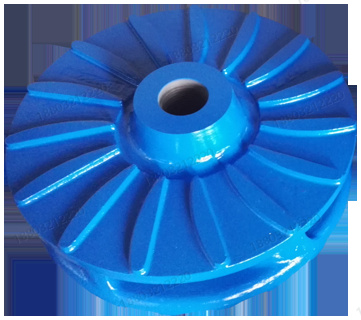
The impeller is the only part that does work and the most expensive wear item. A wrong grade means another strip-down within months. Material, construction, failure patterns and acceptance are covered below.
Figures here come from the charts, the basic part number index and the manuals on file. Anything without a public source is marked as per supplied documents rather than inferred.
Wear resistance in high-chrome iron comes from carbides and toughness from the matrix. Grades differ in carbide volume and form, and in matrix structure.
A05 / Cr26: the mainstay for severe abrasion. Typically HRC 58-62, suited to angular coarse solids at high density. High hardness comes with brittleness, so impact zones need attention.
A49: corrosion first. An austenitic matrix with carbides; lower hardness than A05 but resistant to sulphuric acid at pH 4, alkali at pH 13 and moderate chloride, common in FGD.
Cr30A: more carbides for thin, heavily worn parts. Further hardness and wear resistance at the cost of machinability and toughness; values follow the supplied documents.
Higher grade is not automatically better. With corrosive media, solve corrosion before abrasion. Pushing hardness alone can let the matrix erode first and take whole carbide plates with it.
CONSTRUCTION
Four details worth checking on the impeller
Two impellers may share the number 147 yet differ in details that change life and flow.
Closed or semi-open. Closed impellers are efficient and suit fine solids; semi-open types pass larger particles with slightly lower efficiency.
Back vanes. Vanes on the back shroud reduce axial thrust and leakage and push solids away from the seal; without them seal life drops noticeably.
Threaded mounting and release ring. The impeller threads onto the shaft and tightens with rotation. Use the release ring or a proper spacer when removing it; hammering damages thread and shaft end.
Casting quality and balancing. Shrinkage, slag and uneven sections turn into perforation and vibration in service. Proper parts are inspected and balanced; cheap ones save exactly there.
FAILURE MODES
Read the worn part before changing the grade
Before pricing a replacement, look at how the old one failed. Each pattern points to a different material change.
Pattern
Cause
Action
Even thinning, shortened trailing edge
Normal abrasion with aggressive solids
Keep grade and shorten the cycle; one step harder is possible
Deep grooves or streaks
Flow deflection or foreign bodies
Check suction and pipework first
Chipped or broken vane roots
Coarse impact with too much hardness
Move to a tougher grade or wide-passage build
Honeycomb pitting near the eye
Cavitation from low NPSHa
Fix suction or speed; material will not solve it
Through cracks or plate spalling
Thermal shock, assembly stress or casting defect
Review assembly and operation, require inspection
COMPARISON
High-chrome versus rubber impellers
Item
High-chrome
Rubber
Particle size
Coarse, angular
Mainly fine
Corrosion
Limited; A49 for mild acid and chloride
Mild acid and alkali; not oil or oxidisers
Weight
Heavy, needs lifting gear
Light, easy handling
Failure mode
Gradual thinning, predictable
Cuts, tears, debonding; sudden
Price
Higher
Low on small parts, close to metal on large ones
Metal and rubber impellers interchange on some sizes, but liners and clearances must match as a set; mixing wears out fast or loses flow.
FAQ
High Chrome Slurry Pump Impeller: common questions
How long does a high-chrome impeller last?
There is no single figure; the same model can differ severalfold between tailings and gypsum duty. Log actual hours and failure pattern and set the cycle from your own data.
Change the impeller and liners together?
Yes. Clearance is set by impeller and throat bush together; a new impeller against worn liners loses flow and wears faster.
Can a high-chrome impeller be copied from a worn part?
Yes, from a drawing or measured profile, not from the worn shape itself. Confirm the grade and balancing requirement as well.
How can I tell it is really high-chrome?
Check hardness, section structure and the material certificate. A file and hardness tester give a first indication; spectrometry or chemical analysis settles it.
NEXT STEP
Send the model and duty; we check the part
For pumps, send medium, flow, head, density and installation. For parts, send model, frame code and basic number. We reply within one business day.